Last January, I set my reading goal for the year to 75 books, 25 less than the year prior, to give myself a little room. When I predicted at that time that the goal was easily attainable as long as I stayed single, I had no idea how precisely right I would be: Kari and I started dating in the spring of 2025, and by the end of the year, I had read only 53 books. To really drive the point home: from the time Kari and I had our first date in May through to the end of the year, I read exactly 14 books.
I have zero regrets, naturally. It was a very, very small price to pay. And I thoroughly enjoyed almost everything I read in 2025. With that said, here is…
What I Read
I started the year with what is now an annual tradition: reading Herman Hesse’s Siddhartha, a tale that follows the life of Siddhartha, the son of a Brahmin in colonial India. Despite being written over a hundred years ago and set in a foreign, inaccessible time and place, Siddhartha is inspirational, poignant, and immensely relatable. As an added bonus, it’s a quick read at just over 100 pages. I can’t think of a better way to cleanse the palate for a new year.
Below is the full list of books read in 2025 (excluding school textbooks), alphabetized by author/editor last name. I’ve highlighted my favorites.
- Pride and Prejudice by Jane Austen
- The Modern Myths by Philip Ball
- Flaubert’s Parrot by Julian Barnes
- Notes from No Man’s Land: American Essays by Eula Biss
- Wuthering Heights by Emily Brontë
- Naked Lunch by William S. Burroughs
- Writing Fiction: A Guide to Narrative Craft by Janet Burroway
- The Artist’s Way by Julia Cameron
- The Mouse and The Motorcycle by Beverly Cleary
- Robinson Crusoe by Daniel Defoe
- Slouching Towards Bethlehem by Joan Didion
- A Study in Scarlet by Arthur Conan Doyle
- James by Percival Everett
- To Your Scattered Bodies Go by Philip José Farmer
- (x2) The Sound and the Fury by William Faulkner
- The Great Gatsby by F. Scott Fitzgerald
- Madame Bovary by Gustave Flaubert
- Mythology by Edith Hamilton
- Siddhartha by Herman Hesse
- How to Be an Antiracist by Ibram X. Kendi
- The Jungle Book by Rudyard Kipling
- To Kill a Mockingbird by Harper Lee
- The Secret History of Wonder Woman by Jill Lepore
- Elmer Gantry by Sinclair Lewis
- One Hundred Years of Solitude by Gabriel García Márquez
- The Sum of Us by Heather McGhee
- Happy City by Charles Montgomery
- Despair by Vladimir Nabokov
- The Eye by Vladimir Nabokov
- Glory by Vladimir Nabokov
- Invitation to a Beheading by Vladimir Nabokov
- King, Queen, Knave by Vladimir Nabokov
- Laughter in the Dark by Vladimir Nabokov
- The Luzhin Defense by Vladimir Nabokov
- Mary by Vladimir Nabokov
- Pale Fire by Vladimir Nabokov
- Metamorphoses by Ovid
- The Four Agreements by Miguel Ruiz
- The Comedy of Errors by William Shakespeare
- Henry VI, Part 1 by William Shakespeare
- Henry VI, Part 2 by William Shakespeare
- Henry VI, Part 3 by William Shakespeare
- Lucrece by William Shakespeare
- The Taming of the Shrew by William Shakespeare
- The Two Gentlemen of Verona by William Shakespeare
- Venus and Adonis by William Shakespeare
- Heidi by Johanna Spyri
- Of Mice and Men by John Steinbeck
- Treasure Island by Robert Louis Stevenson
- The Adventures of Tom Sawyer by Mark Twain
- The Undocumented Americans by Karla Cornejo Villavicencio
- The War of the Worlds by H.G. Wells
- Stuart Little by E.B. White
Takeaways From 2025
1) The Mouse and the Motorcycle by Beverly Cleary is just as fun to read as an adult as it is as a kid.
2) Flaubert’s Madame Bovary will be re-read, probably many times. Having never read it before, it’s fascinating to see how influential Flaubert’s masterpiece has been and remains to other authors (such as Nabokov). Plus, it’s entirely non-put-downable.
3) Always lingering in the outskirts of my mind but new to me this year, Joan Didion is exactly the vibe I imagined her to be, offering exactly the lens through which to see the world I imagined she would. Top shelf. I’m looking forward to reading everything of hers I can.
4) Having read Elmer Gantry poolside in my youth, my re-reading of it this year provided the lovely dip into reflections of the past that I had anticipated. Also, just a great read.
5) I have recommended Happy City more than any other work of nonfiction this year. For anyone even mildly interested in or curious about urban planning, the madness of urban sprawl, and how to improve the quality of life for everyone in cities, this is the book you want. And even if you’re not interested, you should read it anyway.
Longer Thoughts
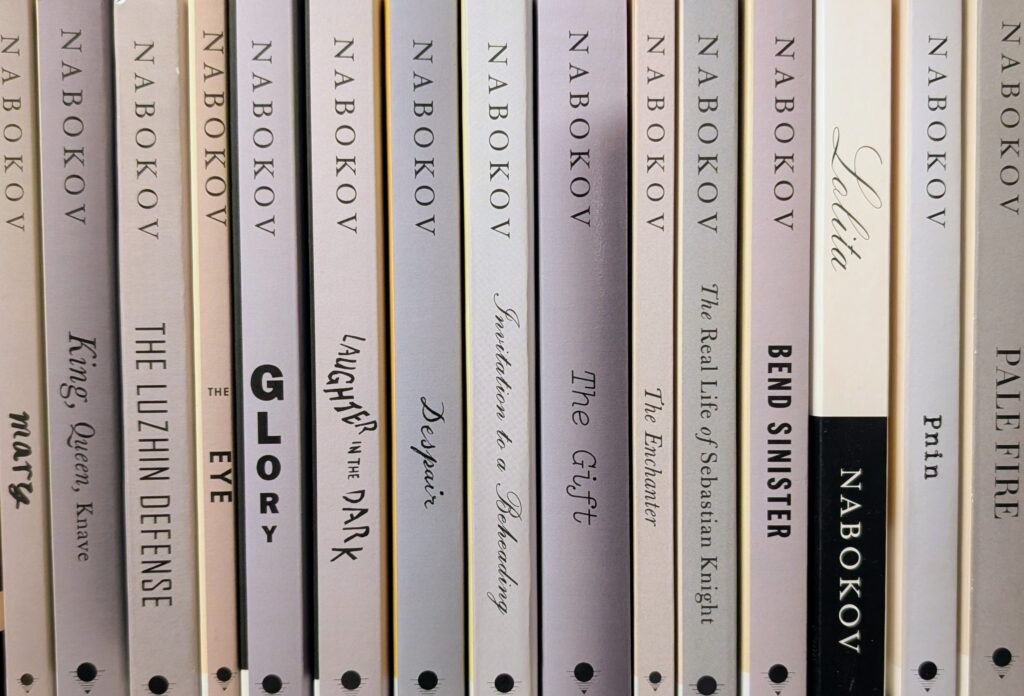
I held off on publishing this list because of a compulsion to finish Vladimir Nabokov’s novel The Gift (see below), which I completed on Thursday morning. I began the book in October and felt I needed to finish it even though it obviously doesn’t count towards last year’s total. Life got in the way of my reading it (see above), but The Gift is also, by far, Nabokov’s most complex and challenging novel. At least, of the novels I’ve read.
Let me back up a little bit, though. Early in the year, I realized how silly it was that I hadn’t read everything by the one author whom I’ve adored for decades. I read a few of Nabokov’s works prior to 2025 (Glory, Lolita, Pnin, and all of his short stories repeatedly), but there was so much I hadn’t. Starting with his earliest Russian novel, Mary, I began working my way chronologically through his superb collection of émigré novels through to The Gift. And then, well, you know the rest. Of Nabokov’s fictional work, I have one short Russian novella (The Enchanter) left before moving on to his novels written after he moved to the United States, only a handful of which I haven’t already read. And then there is all of his nonfiction, including his university lectures, that I can’t wait to read!
As the year progressed, I set another goal for myself: to read all of William Shakespeare’s works. While I never enjoyed reading Shakespeare before, I’ve found myself fully, gleefully, and thankfully immersed in his plays and poetry this year. The motivation to read him wasn’t out of compulsion, though: his influence on literature is so undeniably profound that it’s almost essential to have, at a minimum, a basic grasp of his work to better appreciate and understand so much that has come after him. I’m still not a fourth of the way through his oeuvre, but this slow carriage ride over the hills and through the valleys that lie between Stratford-Upon-Avon and London is sublime.
Looking Ahead
Included in the collection of works I’d like to tackle this year are Homer’s epics (that I didn’t get to last year), the rest of The Canterbury Tales (that I didn’t finish last year), and the King James Version of The Holy Bible (that I read somewhat in childhood and youth). I’d like to read some of the major religious texts in the coming years, and I thought the Bible would be a good place to start, especially given the state of affairs in the US today. I’ll certainly finish the rest of Nabokov’s works, both fiction and nonfiction. And I’ll make more headway on Shakespeare’s plays if I don’t finish them altogether as well.
I’m also going to deep dive into Russian literature. Having that foundation will allow me to absorb Nabokov’s works much more deeply on subsequent reads. Plus, there’s just so much to explore in the sea of Russian literature, and I have only splashed around at the surface.
There are plenty of books on my shelves waiting to be read, so I shouldn’t need to wander through any bookstores, brick-and-mortar or virtual, for a few months. But when has that ever stopped me?
And that’s it! I’m looking forward to the year ahead in reading, and I hope everyone’s reading journey in 2026 is deeply satisfying!